
This is the last of our four stories of Odin and the Mead of Poetry. To begin at the beginning, read Kvasir: Man of Spit, then Fjalarr and Galarr Give up the Mead and Odin’s Labor.
In the last story, Odin, calling himself Bölverkr (‘Evil-Doer’), did a summer’s work of nine men for the giant Baugi. His only wage: one drink of the Mead of Poetry, which Baugi’s brother Suttung kept hidden inside the mountain Hnitbjörg. When winter came, Bölverkr claimed his wage, and Baugi went with him to ask his brother for that drink. Suttung refused flatly. So Bölverkr proposed a trick, and Baugi agreed.
Odin and Baugi
Bölverkr produced an auger named Rati and told Baugi to bore into the mountain. Baugi drilled, then announced he was through. Bölverkr blew into the hole and the rock dust blew back into his face. Baugi was lying, hoping to be rid of him. So Baugi bored again, and this time the dust blew inward.
Bölverkr turned himself into a snake and slithered into the hole. Baugi stabbed after him with the auger and missed. The snake was gone, into the dark heart of the mountain.
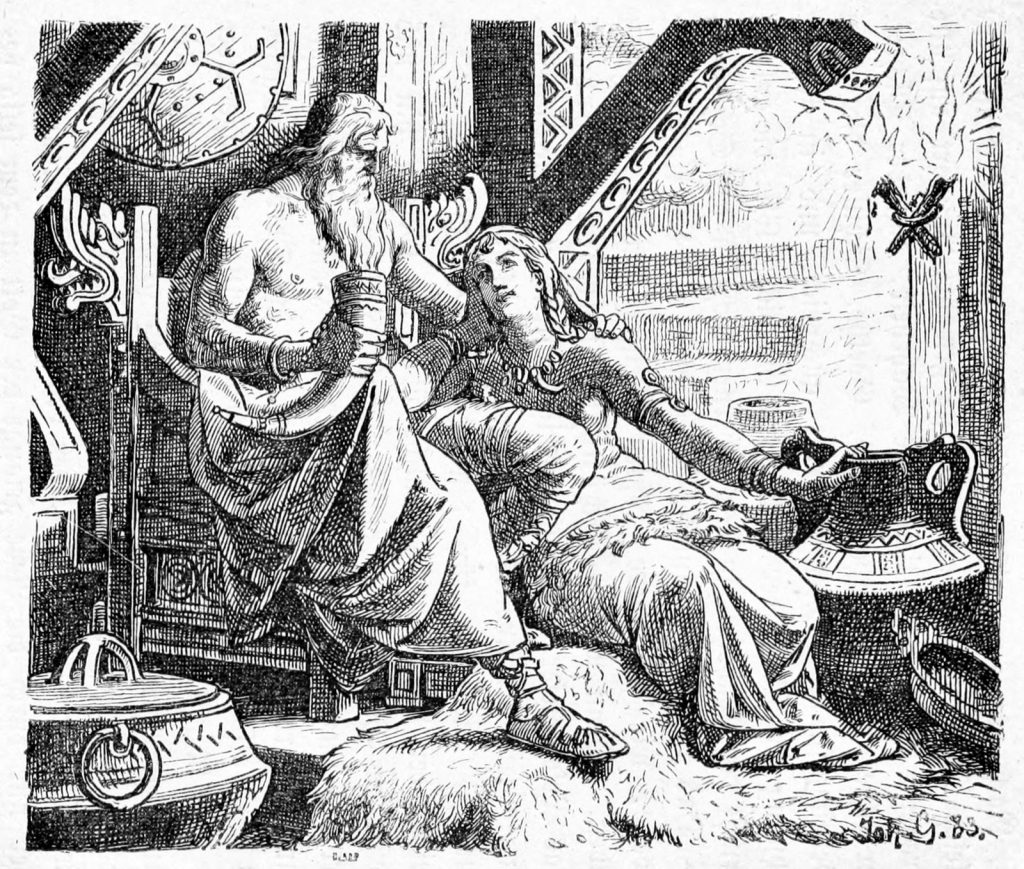
Odin and Gunnlöð
Inside, Odin took his own shape again. There sat Suttung’s daughter Gunnlöð, guarding the mead in three vessels: the kettle Óðrerir and the vats Boðn and Son.
Gunnlöð asked him who he was and where he came from. Odin responded that he was a thirsty traveler. Gunnlöð said she only had the Mead of Poetry, and she couldn’t give him even a sip. Odin begged for it, but Gunnlöð was steadfast.
Gunnlöð finally agreed: three nights with her, and he could have three drinks. After the third night he took his three drafts, and in three swallows he drained all three vessels dry. Then Odin became an eagle and flew for Asgard.
Chasing Odin-Eagle
By this time, Suttung knew that Odin had stolen the Mead of Poetry. When Suttung saw Odin-Eagle flying away from the cavern, Suttung transformed himself into an eagle to give chase.
Full of mead, Odin-Eagle flew heavy and slow. Behind him, Suttung-Eagle was gaining. Snorri tells us in the Skaldskaparmal that Suttung came so close that Odin let some of the mead fly out the back end. Nobody went after that part. Anyone who wants it can have it: it is “the rhymester’s share,” the portion for bad poets.
Odin Brings the Mead of Poetry to Asgard
When the gods saw the eagle coming, they set out vessels in the courtyard of Asgard. Odin reached the wall just ahead of Suttung and spat the mead into them. Snorri never tells us what became of Suttung. (If you remember a giant-eagle burning on Asgard’s walls, that is Thjazi, in the story of Idun’s apples.)
Odin gave the mead to the gods, and to those humans who know how to make verse. That is why skalds called poetry “Kvasir’s blood,” “Suttung’s mead,” and “Odin’s catch” or “Odin’s drink.”
Odin and the Mead of Poetry in Hávamál
The Poetic Edda remembers it differently. In Hávamál (stanzas 104-110), Odin himself admits he wooed Gunnlöð and then abandoned her in tears. The next day, frost giants came to Odin’s hall asking after Bölverkr: had he reached the gods, or had Suttung killed him? Odin, of course, kept quiet. Hávamál also has Odin’s own verdict on it: “Odin swore an oath on the ring. Who can trust him now?” Bölverkr is one of Odin’s many names, and not the most flattering.
Keep reading: the whole tale of the Mead of Poetry begins in Kvasir: Man of Spit, Mead of Poetry Origin. Another of Odin’s adventures is told in Odin and Sleipnir Flee Hrungnir and Gullfaxi.
Sources
- Snorri Sturluson, The Prose Edda (Skaldskaparmal), translated by Arthur Gilchrist Brodeur (1916), Wikisource; Hávamál st. 104-110, Poetic Edda, translated by Henry Adams Bellows (1923), Wikisource; The Definitive Guide to Norse Mythology by Finn D. Moore (2022).
- Jackson Crawford on YouTube, Óðrerir: The Norse Mead of Poetry