
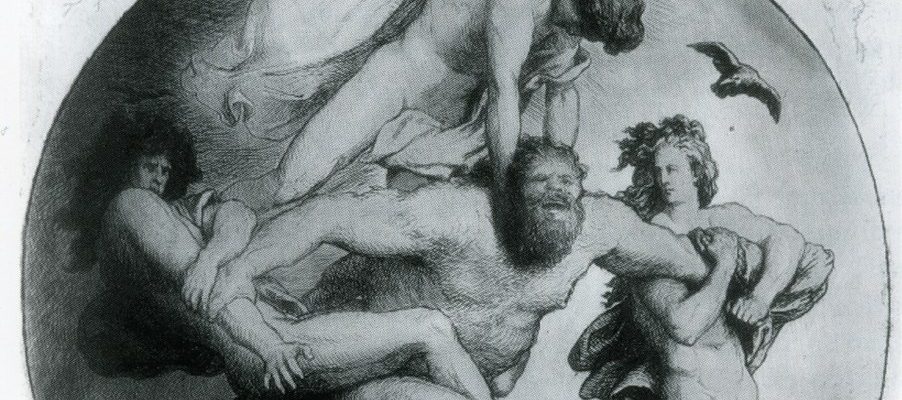
The Norse world is built from a corpse. After the cow Auðhumla licked the first gods out of the ice (see Part 1), three brothers, Odin, Vili and Vé, turned on the giant Ymir. The sources never really say why. Snorri Sturluson simply calls Ymir evil; perhaps that was reason enough, or perhaps the brothers needed raw material for a world. Of the three, Odin became the great god of Norse myth, while Vili and Vé all but vanish from the record.
Ymir’s Death
Ymir, also called Aurgelmir, was the first living being in Ginnungagap and the ancestor of all the frost giants, including, on their mother Bestla’s side, the brothers’ own kin. When Odin, Vili and Vé killed him, so much blood poured from his wounds that it drowned every frost giant but one couple: Bergelmir and his wife, who escaped in a boat (or on a mill-frame, in some readings) and started the giant race anew. As the flood receded it became the seas and lakes.
Midgard’s Birth
The brothers took Ymir’s flesh and created the Earth. From Ymir’s hair, they made trees, and his bones became the mountains. Ymir’s teeth, jaw, and broken bones became rocks and pebbles. To protect Midgard from the giants, the brothers built a barrier from Ymir’s eyebrows or eyelashes, depending on the story being told.
Rise of the Dwarves
In Snorri’s telling, maggots grew in Ymir’s flesh, and the gods gave them human understanding and human shape. These were the dwarves, who live in rocks and in the earth. (The poem Völuspá tells it differently, with the dwarves shaped from the blood and bones of giants.) The gods set four dwarves, Austri, Vestri, Norðri and Suðri (East, West, North and South), at the corners of the world to hold up Ymir’s skull, which became the sky.
Into the Sky
The brothers threw Ymir’s brain into the air, and it became the clouds. Then they took sparks blowing out of Muspelheim and set them in the sky as stars. The world was built. All it lacked was people. (Next: Part 3, the Creation of Man and Woman.)
Sources: Children of Ash and Elm: A History of the Vikings by Neil Price (2020).
https://sites.pitt.edu/~dash/creation.html
https://www.worldhistory.org/Ymir/